


 Find additional Shakespeareances
Twelfth Night or What You Will
Getting the Lasting Laughs
American Shakespeare Center, Blackfriars Playhouse, Staunton, Virginia
Saturday, February 28, 2026, C–5 (center stalls); Friday, May 1, 2026, C–5
Directed by Nana Dakin
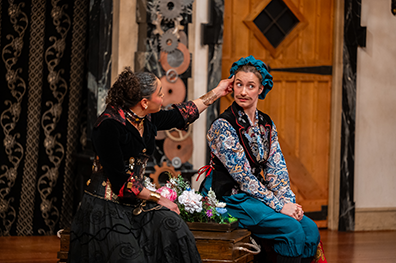
Olivia (Angelique Archer, left) checks out, in detail, the Duke Orsino's love messenger Cesario, nee Viola (Summer England) in the American Shakespeare Center's production of William Shakespeare's Twelfth Night or What You Will at the Blackfriars Playhouse in Staunton, Virginia. Photo by Madison Patterson.
A word often repeated in a play’s script is a thematic clue. In a review of that play, a word often repeated is a measure of value. As I combined my transcribed notes of two performances of the American Shakespeare Center’s production of William Shakespeare's Twelfth Night or What You Will—seeing the play at the beginning and the end of its Blackfriars Playhouse run in Staunton, Virginia—I noted how often I used one particular word: laugh.
Laugh and its derivatives appear 18 times in my combined notes of the performances I saw at the end of February and the beginning of May. Two of those references come in character portrayals: the rest describe audience reactions. Some examples straight from my notes:
- The "buttery bar" joke gets a laugh
- "Give me leave to prove you a fool" gets a laugh
- First Cesario/Olivia lines are earning laughs
- "In his bosom?" Olivia repeats cynically, as is the rest of her line: "In what chapter of his bosom?" which gets a laugh.
- Sebastian sheepishly saying about his twin sister, "though it was said she much resembled me, was yet of many accounted beautiful" gets a laugh
- Viola's "If it be so, as 'tis, poor lady" gets a laugh
- "Think you right: I am not what I am" gets a huge laugh
- "There's vinegar and pepper in't" gets a laugh
- "How much I lack of a man" gets a laugh
- Malvolio's recounting "yellow stockings" and "cross-gartered" gets a laugh, despite—or because of—his roaring it out
- "If this were played upon a stage now, I could condemn it as an improbable fiction" Onken delivers with such aplomb, it gets a big laugh [Christopher Joel Onken playing Fabian]
That’s the point. It’s not that we shouldn’t be laughing at these lines but that Shakespeare is earning these laughs via the cast's accomplished execution of his script. In addition to the actors' textual intelligence, their characters are richly rendered, including relying on subtle expression over physical clowning to land the play's slapstick elements. Referring directly from my notes again, "the Malvolio curtain trick is soooo affective. Gets a big laugh and so thematically apt." Yeah, I misspelled effective, though affected could be what I was feeling in the moment.
Nana Dakin's sure-handed direction is text-focused, starting with an efficiently effective cut of the script. With scenes pared to their comical and emotional essentials, the play comes in at 2 1/2 hours including a 15-minute intermission. She also is working with what is, pound for pound—or, rather, actor for actor—one of the most accomplished ensembles I've seen on the Blackfriars stage. That's saying a lot because I've seen a greater share of accomplished ensembles on that stage over the years than almost any other theater; as many as I've seen with England's Royal Shakespeare Company and National Theatre. The acting depth in this company goes beyond its front line to include understudies. Playing Viola, Lydia Sophia Christenson filled in so adeptly for established Blackfriars star Summer England in the February presentation that Christenson rightly earned a rousing individual curtain call at the other actors' insistence.
Whoever is playing Viola, she makes one of the most dramatic entrances of any Viola I've seen since my very first live Shakespeare play, in 1974 at the now-defunct American Shakespeare Theatre in Stratford, Connecticut. In that production, Carole Shelley’s Viola seemed to be thrown onto the stage by a heaving wave of water. For this production in the Blackfriars Playhouse, the world’s only re-creation of Shakespeare’s indoor theater and using his company’s original staging principles—meaning no electronics or digital effects—Viola rolls onto the stage through the back curtain in a blue fabric that unspools as she nears the stage's skirt. There she is stopped (literally saved from falling overboard) by the Captain (Blake Henri). In this small role, Henri displays his skills as a textually driven character actor. "There is a fair behavior in thee, captain," Viola says, and Henri fully plays the validity of her observation. When she offers him money for describing how her twin brother, Sebastian, "like Arion on the dolphin's back, I saw him hold acquaintance with the waves so long as I could see," he refuses to take Viola's purse. If not outright lying to Viola to comfort, it seemed Henri's Captain was at least exaggerating Sebastian's chance at survival and felt he didn't deserve her payment, such was the subtle nuances of his performance.
How does this same actor achieve subtlety playing Malvolio, the Countess Olivia's steward and malcontent Puritan? Henri does and doesn’t in perfectly balanced turns.
The play’s Illyria setting is presented in Balkan steampunk stylings via the costumes by Elizabeth Wislar: multicolored shirts, knee-length breeches, gothic gowns, and brightly colored accoutrements—or hair in the case of blue-coiffed Maria (a Betty Boop-voiced Angela Iannone). Feste the Fool (Isabel Lee Roden) is wearing pretty much all the above fashions. The only set decor is a menagerie of gears on the back columns plus wood trunks and flower boxes as necessary.
The most steampunk of Illyrians is Malvolio, all in black, with a long coat featuring military ribbons, badges, and silver chains, and a black hat with goggles atop its brim. Henri's is a most dangerous Malvolio, oozing meanness in his demeanor whether he is returning Cesario's supposed ring by displaying it on his finger in a vulgar salute or pushing Feste away during the night revelries by planting his palm on the fool's forehead and shoving with all his might. This Malvolio has not a bit of pleasantry in his manner except when he's trying to court Olivia (Angelique Archer) and it's a creepy kind of pleasantry.
Yet, Henri garners the biggest laughs of the production on three occasions. One is his seemingly disembodied head suddenly popping through the curtains at the back of the stage causing a frightful shock to Toby (Christopher Seiler) standing nearby. What makes the moment so frightfully effective? As Malvolio steps through the curtain, we see he is wearing a luxurious cloak exactly matching the ornate silver-embroidered, black fabric of the curtain. It's one of the great special effects I've seen on the Blackfriars's non-digitized stage. Malvolio wears the curtain cloak again when he pulls off the cloak to reveal his cross-gartered yellow stockings under an Illyrian kilt. Malvolio's other great laugh-a-lot is his role in the box tree scene, a killer masterclass in staging the play's famous comic centerpiece that I'm leaving to the Aside below for a full description.
It turns out Malvolio's shoving Feste aside is a key piece of stage business revealing thematic strands of the plot I've never noticed before, and this is the 32nd live production I've seen of this play.
Malvolio engages with two primary rivals, Olivia's waiting-gentlewoman, Maria, and Olivia's fool, Feste. With Maria, theirs is a power struggle in who holds sway with Olivia and which of them rules the household. This leads to Maria pranking Malvolio with the fake love letter from Olivia, but her ultimate victory is not in making Malvolio act foolish but that in doing so, she marries Toby as reward. Due to smart casting decisions, Maria herself announces her marriage to Olivia's uncle, victoriously showing off her wedding ring to Malvolio and thereby socially trumping him in rank: her marriage to Toby gains her entrance into the noble class that Malvolio has long dreamed of for himself. This leaves Henri's Malvolio frustratedly speechless. Malvolio’s rivalry with Feste is in part due to their opposite approaches to life, but more keenly for Olivia’s affections. In the final scene, Feste turns the insults he's suffered from Malvolio back on the steward, describing how "the whirligig of time brings in his revenges." Malvolio can't suffer this comeuppance. "I'll be revenged on the whole pack of you!" he says, and Henri stomps off stage in a threatening rage. And this is amid this comedy's supposedly happy ending.
After Malvolio shoves Feste away headwise—the only member of the revelers he can physically attack as Sir Toby Belch and Sir Andrew Aguecheek (Justin McCombs in a sublimely brilliant portrayal of the foolish knight) are off limits—the Fool runs off in an angry fright. The next time we see Feste he's hanging out at the Duke Orsino's court. This might reflect on Feste's absence from Olivia's household at the beginning of the play. Perhaps in Olivia's insistence on maintaining a grieving household, the steward Toby has gained a clear upper hand on Feste and made living there intolerable for the fool. In fact, it is the fool who sets the household aright. When Feste breaks through to Olivia with his "Good madonna, give me leave to prove you a fool," which he then does "dexteriously," Olivia hugs Feste, indicating how much the fool means to her and how much she's missed him even as she's sworn to mourn the double loss of her father and brother. Olivia clearly needs, even wants, some joy and laughter. This reconciliation, however, exasperates Henri's Malvolio.
Roden's characterization of Feste is interesting and not entirely clear to me. That’s not a criticism as an observation of how enigmatic the character is in the text. Roden is a stellar talent as an actor, singer, guitarist, and songwriter: she wrote the music for all of Feste's songs in this production, and his songs about death and love lost come from deep within. "Come Away, Death" that Feste sings for the Duke Orsino (Topher Embrey) and Cesario (Viola in disguise) is deeply moving in a haunting Sinead O'Connor way, and Roden gets prolonged applause from the audience upon its conclusion.
Another reason for Feste's quick departure from Olivia's household is one of stage practicality. It gives way for the sudden, generally unexplained appearance of Fabian, whose role in the Olivia household is not clearly defined. Critics have long commented on what to me seems to be Shakespeare writing himself into a casting bind. Nevertheless, though Fabian is essentially a throw-in character, he proves enticingly three-dimensional in Onken's performance. One specifically noteworthy Fabian moment comes when he convinces Sir Andrew Aguecheek , who is courting Olivia as part of Toby's scheme to defraud him, that Olivia's behavior toward Cesario in Aguecheek's presence was intended to "put fire in your heart and brimstone in your liver." Across the stage, Seiler's Toby is confused by Fabian's comments until he catches on that Fabian is gulling Aguecheek, too. It's subtle testimony that Fabian is every bit an established member of this household.
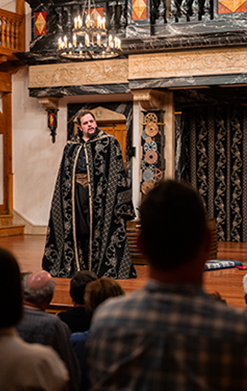
Left, Malvolio (Blake Henri) makes an impression in his curtain-matching cloak in the American Shakespeare Center's staging of William Shakespear's Twelfth Night or What You WIll at the Blackfriars Playhouse in Staunton, Virginia. Below, Malvolio wearing yellow stockings and cross- gartered, deals with, from left, the blue-haired Maria (Angela Iannone), Fabian (Christopher Joel Onken, center), and Sir Toby Belch (Christopher Seiler, right). Photographs by Madison Patterson.
This company has 10 actors plus understudies. That's less than the 12 the play's script requires with doubling but more than the eight that the American Shakespeare Center has had to settle for the past couple of years as it recovers its post-covid financial footing. Nevertheless. this production is a case study in managing the characters necessary to make the whole story whole. One is to play Fabian as an always-purposed character. Once Shakespeare realized he needed another character to spell Feste so he can do his fooling in the court as well as at Olivia's house, he drew a fully formed, singular character in Fabian. When Maria in plotting out her prank says "let the fool make a third," this production has her say "Fabian" instead. And Onken gives Fabian much heft with his dynamic portrayal, holding his ground on the stage with Toby, Aguecheek, and Maria. But Onken is also playing Sebastian, so he can't be on stage as Fabian in the last scene. Feste and Maria take over Fabian's lines for that scene. It's seamless character management, and the play doesn't suffer by the lack of another couple of actors.
So much for the subplots. On to the main plot, the love triangle involving Viola disguised as Cesario in love with Orsino who is in love with Olivia who falls hard for Cesario. Orsino can be a hard nut to crack, using "nut" with its two obvious meanings. He is so out there, his court attendants roll their eyes when he launches into one of his metaphorical speeches on love. He is quite sexist, too, and shows a violent streak in threatening to kill Cesario whom Orsino no doubt loves. Because this production grounds everything on fealty to the text, the accomplished Shakesperean Embry finds his character not necessarily in Orsino’s lines but in Viola.
I've seen a number of actors try to find a character in which they can fit Orsino's surface characteristics. Some work, like the rock star version by Scott Wentworth in the 1994 Stratford Festival of Canada production. But to know Orsino is to listen to Viola's heart, and Embrey does that while maintaining the Duke's silly romantic pining and poses, opening the play on the balcony, one leg hanging over the railing as he contemplates a red carnation in his hand. In turn, Embrey plays an Orsino that a Viola would fall for; commanding, poetical, and kind to her, the “boy” with the slight mustache.
Embrey also takes another approach to understanding the character and nails a portrait of an Orsino who is prone to bouts of depression. A turning point in his character and in his relationship with Cesario/Viola comes when Feste plays “Come Away Death.” Early in the song, Orsino rushes down from the balcony with a surprised Viola following. Orsino listens to the song with haunted eyes, and Viola's Cesario keeps a wary watch on him. This is the first time I've shared depression’s secret handshake with the character of Orsino. The influence on Orsino's portrayal is in his overstated romanticism and copious references to his anatomy (heart, brain, liver, indigestion), as well as in Viola's regard for him. This factors into the earnestness with which she woos Olivia for him, fighting for Orsino's love for Olivia. It's easy to discard Orsino as a misogynistic and romantic showboat, but the Viola we know would see through that, expressing her true feelings in asides and soliloquies. This makes for the more engaging, and comical, character that Embrey presents.
Granted, so much irony is running through the emotional tumbleweed that is Viola at this moment: she has fallen hard for Orsino and can't see why Olivia doesn't feel the same way. In Christenson’s performance, she describes the speech she has to deliver Olivia as "Excellently well penned" with such enthusiastic pride bordering on awe that I wonder if Orsino, not her, penned it. In England’s performance, when Orsino claims women “lack retention,” she gives the audience a sour look, not in disgust but with the acknowledgment that he still needs work. But both Cesario’s stand up to Orsino: "I know too well what love a woman can hold."
At this point, the two actors playing Viola diverge. While Christenson is a beguiling Viola and Cesario, England remains strictly Viola and dives into the depths of what she’s going through as a woman of means disguised as a servant-class boy in love with a duke who is using her as go-between courting a countess who has fallen for her. One scene exemplifies how England plays Viola's multi-emotional bearings navigating her complicated situation. After Malvolio, on Olivia's orders, returns to Viola the ring she never gave Olivia (though Malvolio claims to have seen Cesario "peevishly" throw it to Olivia), Viola is left to ruminate on "what means this lady?" and determines in a frightful realization that “She loves me sure.” A couple of lines later she delivers the line “I am the man” in a giddy singsong tone. A few lines more and she's singsonging, “What will become of this?” but her tone is now one of uncertainty. We see manifistation of that tune's bearings when Viola pushes back against Orsino's contention that women lack retention to love with as much passion as he does. She recounts the story of her “sister,” meaning herself, whose love for a man wasn't requited and fell into a "green and yellow melancholy" with which she "sat like Patience on a monument, smiling at grief." England mines a deep sadness as she says, “She never told her love,” outwardly speaking in the third person but inwardly speaking in the first person.
While Orsino is a hopeless romantic courting Olivia with words and song, Archer plays Olivia as a tyrannical romantic courting Cesario/Sebastian with lust and threats. Over the course of the play, Archer goes so far as to suggest Olivia is a dominatrix. That’s supported in the text. She flashes sweet and demanding with Cesario and ends up doing the same upon first meeting Sebastian, whom she thinks is Cesario. Given their actual status of power, a reverse dynamic is at play between Olivia and Orsino: even the way Olivia invites Orsino to lunch in the final scene is in a remonstrative tone. This is my interpretation of what the production might be aiming at, but Toby's testimony supports this conclusion when he tells Aguecheek that his niece would none of Orsino. “She'll not match above her degree, neither in estate, years, nor wit; I have heard her swear't,” Toby says. That line is groundwork for building Olivia and the romantic relationships she engages.
 Illyria's
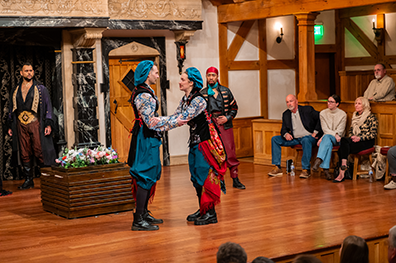
Duke Orsino (Topher Embrey, back left) and Antonio (Darin F. Earl II, back right) watch in shock as Sebastian or Cesario make division of themselves as Sebastian (Christopher Joel Onken, the twin on the left) and Viola (Summer England, the twin on the right) reunite in William Shakespeare's Twelfth Night or What You Will at the American Shakespeare Center's Blackfriars Playhouse in Staunton, Virgnia. Photo by Madison Patterson.
Illyria's
Duke Orsino (Topher Embrey, back left) and Antonio (Darin F. Earl II, back right) watch in shock as Sebastian or Cesario make division of themselves as Sebastian (Christopher Joel Onken, the twin on the left) and Viola (Summer England, the twin on the right) reunite in William Shakespeare's Twelfth Night or What You Will at the American Shakespeare Center's Blackfriars Playhouse in Staunton, Virgnia. Photo by Madison Patterson. The reveal of the twins in the final scene is brilliantly staged, allowing the audience to see everybody's reaction: the twins', Olivia's, Orsino's, Feste's, and most especially Antonio's (Darin F. Earl II) as he comes forward and says, “How have you made division of yourself?" I don't ever recall laughter so vocal as Earl's delivery receives, for it is perfectly set up and timed. Antonio's next two lines in the text have been cut, so that after the laughter dies down, "Most wonderful" bursting forth from Olivia serves as an applause line. England's Viola looks on Sebastian with confidence as he works out the possibility that she is his sister. She already suspected he was in town and knows it’s him, but now she shows patience while making sure Sebastian is not a specter, a signal of whether she believed the Captain's optimism at the play's beginning.
The last big laugh of the show comes from Malvolio, ironically. He appears on stage still wearing his cross-gartered yellow stockings as he accuses Olivia of having "done me wrong, notorious wrong." As Olivia reads the Maria-penned letter that gulled Malvolio into his behavior that, in turn, got him jailed as a madman, Malvolio continues his railing. Henri maintains the stewards' intensely angered bafflement, and in that tone speaks some of what, taken out of context, would sound ludicrous and does so here: "Bade me come smiling and cross-gartered to you, to put on yellow stockings, and to frown upon Sir Toby and the lighter people." The audience can't help but laugh, even as Malvolio turns to baffled self-pity about being imprisoned in a dark house and "made the most notorious geck and gull that e'er invention played on! Tell my why!" Interesting, though, Malvolio's behavior throughout the play doesn't seem to allow the audience to pity him, and it didn't in the two audiences I sat among, even though Henri's performance has been one of the most hilarious straight men I've ever seen.
When everybody fesses up, and Feste concludes with "Thus the whirligig of time brings in his revenges," Malvolio threateningly says, "I'll be revenged on the whole pack of you" and exits. Twinning the two uses of the word revenge in succeeding lines by two different characters means Malvolio intends to meet revenge with revenge. This Malvolio will do just that, escalating a dangerous cycle, a lingering concern hanging over the proceedings even though Orsino orders Maria to entreat him to a peace which we know won't happen.
This production doesn't attempt to work around Shakespeare's text to attain a comical ending. Roden's Feste seems to be the only character who understands the troubling conundrum upon which the play ends. As the others leave for their banquet, Feste is eft alone on the stage, whereupon Roden begins a solemn rendition of "The rain it raineth every day." As the rest of the cast joins her, they, as an acting ensemble, ease us back from steampunk Illyria to Shenandoah-nestled Staunton. Thus does Shakespeare's whirligig of a play come to a close, capping on a high note one of the greatest comedies ever written as evidenced by the laughter these two audiences maintained throughout the entire play.
Eric Minton
May 27, 2026
ASIDE: Demolishing the Fourth Wall
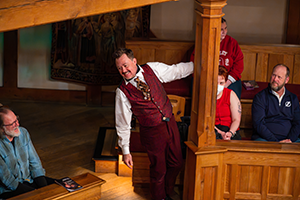
"Get ye all three into the box-tree," Maria instructs Sir Toby Belch, Sir Andrew Aguecheek, and Fabian. A box tree is a tree or hedge made out of an evergreen and often used to form topiaries, according to The Arden Shakespeare's third edition of Twelfth Night. It's indicative of a manor house garden and could have great comic potential as the pranksters hide amid evergreen animal statues to watch Maria's forged letter gull Malvolio into thinking Olivia loves him. The box tree, says the Arden footnote, "is one of the few indispensible stage properties required in this play."
Director Nana Dakin and her American Shakespeare Center cast beg to differ. Why build a stage prop when, at the Blackfriars Playhouse, you have an audience to serve as your topiary?
The actors are Christopher Seiler as Toby, Justin McCombs as Aguecheek, Christopher Joel Onken as Fabian, Angela Iannone as Maria (who leaves the stage during the gulling), and Blake Henri as Malvolio. I didn't get the names of the topiaries.
Carrying trays of flowers, Toby, Aguecheek, and Fabian enter and hand out the flower trays to audience members sitting on gallant stools lining both sides of the stage. The actors deliver their lines as they set up the wood crates, retrieve the flower trays, and lay them on top of the crates—creating literal box trees—and elsewhere on the stage.
Though Toby, Aguecheek, and Fabian initially hide behind the flower-topped crates, they end up moving around the stage and through the audience to keep Malvolio from seeing them, all while shooting off one-liners in response to Malvolio's self-indulging fantasies of becoming "Count Malvolio" (photo 1, below).
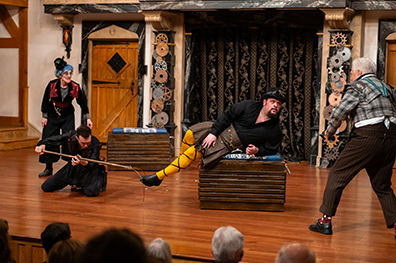
At one point, Aguecheek is hiding next to the stage skirt. He sneezes, and Henri says "Bless you" to a woman in the third row. Aguecheek then literally blends into the audience by squeezing between patrons in the front row and reads a playbill (photo 2). In the May performance, Aguecheek grabs a patron’s sunglasses to disguise himself.
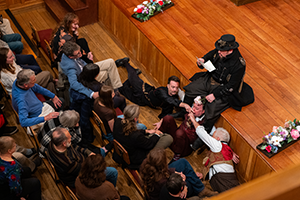
When Malvolio comes forward reading the letter, he sits down on the edge of the stage above Aguecheek sitting on the floor. Malvolio dangles a flower in front of Agueecheek, and Toby and Fabian crawl to Sir Andrew from both sides of the stage to offer their fingers to his nose as sneeze-stoppers (photo 3). This gag offers a nice return on cheap-seat investment as the patrons in the playhouse's upper tier can see what the folks in the lower level cannot, except those sitting in the first two rows.
When Malvolio decides to act out being Count Malvolio, he strolls to a woman on a gallant stool, and in a most gentlemanly manner gestures an invitation for her to stand as if asking her to dance or be his escort. As she stands, Malvolio guides her a couple of steps away from the stool and reaches behind her to take her seat and carry it to the center of the stage to serve as his throne. The woman is shocked and kind of peeved (seriously or playing the role well, hard to tell). Upon enacting his turn as Count Malvolio, Henri returns the stool and gestures the audience to applaud her. It is pretty much the only nice thing this Malvolio does in the entire play.
In the May performance, Malvolio takes the stool from a man, who resorts to kneeling on the floor to watch the scene play out. But as Malvolio describes “Toby approaches,” he motions to the kneeling gallant to approach him, which the gallant does, and Malvolio signals for a sign of respect. The gallant curtsies, which earns applause (photo 4). When Malvolio gets up from the stool and strolls stage left in continuing his soliloquy, the gallant tries to take his stool back. Malvolio stops him, but, again, encourages the audience to applaud the man.
Involving patrons, especially those sitting on the gallant stools, is common practice at the Blackfriars, but I've never seen it so elaborately carried out before. Special kudos for Henri staying in character the entire time, even as he instructs the audience to applaud the gallands. A couple of times, Malvolio himself steps out of character. Trying to decipher the riddling letter sequence M-O-A-I, Malvolio reads it out loud as a word, "mowahee." Then, "M begins my name!!!!!" Blake shouts with alarming surprise at his discovery that it rattles the playhouse's chandeliers. It's one of a few examples—his curtain replicated cloak being another—of just how childish Malvolio can be in Henri's otherwise serious portrayal. At the end of this scene, Malvolio says, "I am happy," and the audience "Awwwww!"s. How such a mean Malvolio can elicit such an affectionate response is testimony to Henri's all-in-and-on-point portrayal, as well as the so-subtly-played ridiculousness we've just witnessed.—EM
Photos by Maddison Paterson
 1
1 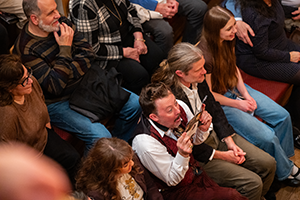 2
2
 3
3 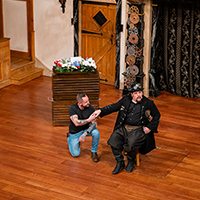 4
4
Comment: e-mail editorial@shakespeareances.com
Start a discussion in the Bardroom
